


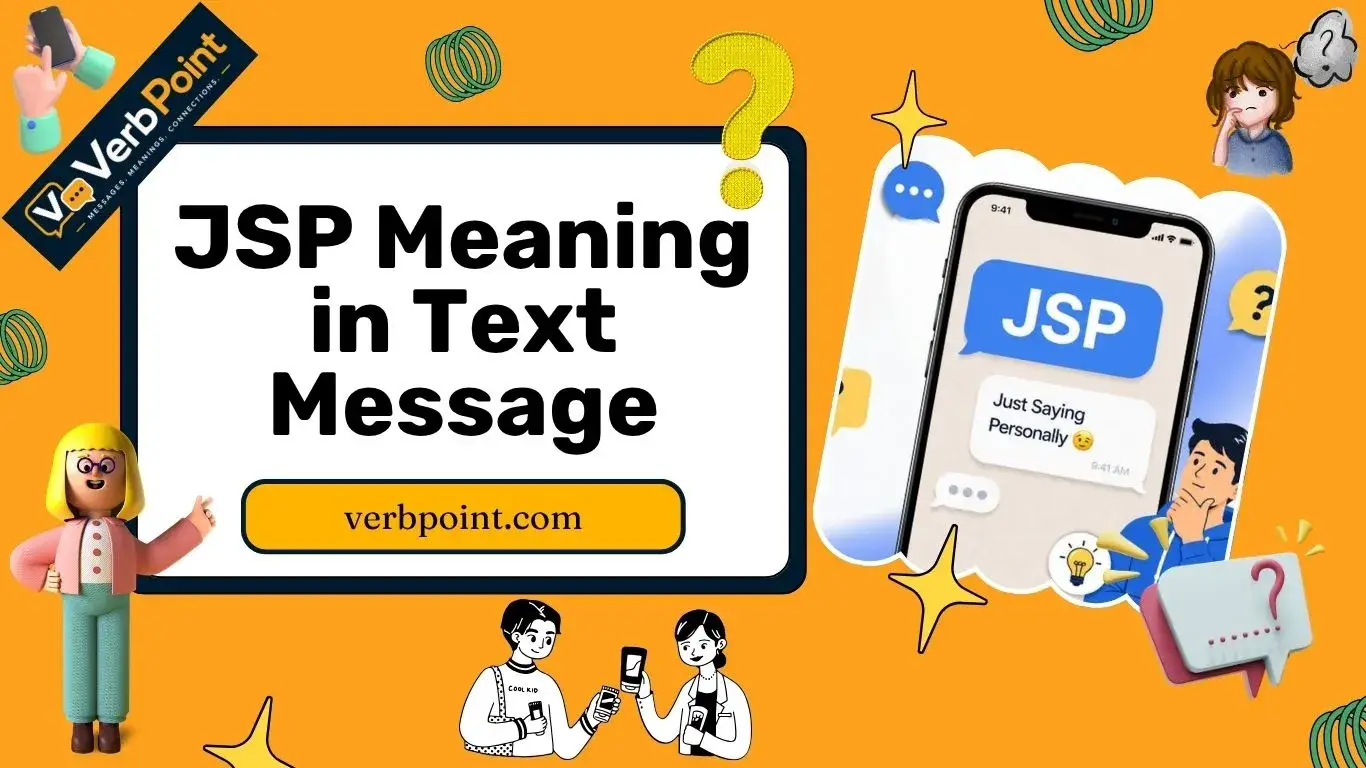
JSP most commonly means “Just Playing” in text messages, online chat, and social media. People use it to show they are joking or teasing, not being serious. However, JSP meaning can also change depending on the context, such as JavaServer Pages in programming or Je Sais Pas in French.
If you’ve seen JSP on TikTok, Instagram, Snapchat, or in a text and weren’t sure what it meant, you’re in the right place. This guide explains every common meaning in simple English with real examples. You’ll quickly learn how to identify the correct meaning in any conversation.
In this complete guide, you’ll discover JSP meaning in text, JSP meaning in chat, JSP meaning on social media, and JSP meaning in Java. You’ll also learn when to use it, how context changes its meaning, and how it compares with other texting abbreviations. By the end, you’ll know exactly what JSP means wherever you see it.
What Does JSP Mean in Text?
If you have received “JSP” in a text message, social media comment, or online chat, it usually means “Just Playing.” People use it to let others know they are joking, teasing, or not being serious.
In most casual conversations, JSP helps avoid misunderstandings. It tells the reader that the previous message was meant for fun and should not be taken literally.
For example:
- “You’re the worst teammate ever… JSP 😂”
- “I was going to block you. JSP!”
- “I ate all your snacks… JSP, they’re still there.”
In all of these examples, JSP softens the message and makes it clear that the sender is joking.
Quick Answer
- JSP meaning in text: Just Playing
- JSP meaning in chat: Just Playing
- JSP meaning in texting slang: A way to show that a message is meant as a joke.
- Most common use: Casual conversations between friends, family, gamers, and social media users.
Tip: Always read the entire conversation before deciding what JSP means. While it usually stands for Just Playing, it can have different meanings in technical or professional discussions.
JSP Meaning in Text Slang
In text slang, JSP stands for “Just Playing.” It is a popular texting abbreviation used after a playful comment to show there was no serious intention behind it.
People often use JSP when they want to:
- Make a joke without offending someone.
- Show they are teasing a friend.
- End a sarcastic message on a positive note.
- Keep conversations fun and relaxed.
Here are a few examples:
✅ “You’re buying everyone dinner tonight. JSP!”
✅ “I deleted your photos… JSP 😂”
✅ “You’re officially fired from the group. JSP.”
In each example, the abbreviation changes the tone from serious to playful.
Why JSP Is Considered Text Slang
Unlike formal English, JSP is part of internet slang and online messaging language. It is commonly used in:
- Text messages
- Online chats
- Gaming communities
- Social media conversations
- Group chats
Because it is informal, avoid using JSP in business emails, professional meetings, or official communication.
What Does JSP Stand For?
The most common expansion of JSP in texting is:
JSP = Just Playing
It tells the other person that your previous message was only a joke.
For example:
Friend: “I can’t believe you forgot my birthday.”
You: “Maybe because we’re not friends anymore. JSP 😂”
Without JSP, the message could sound rude or hurtful. Adding it immediately changes the meaning and shows that you’re only kidding.
Other Meanings of JSP
Although Just Playing is the most common meaning in casual conversations, JSP can also stand for other terms depending on the context.
Some examples include:
- JavaServer Pages in web development.
- Organization or company names.
- Technical abbreviations used in specific industries.
If you’re reading a programming article or talking with developers, JSP almost certainly refers to JavaServer Pages, not Just Playing.
Tip: The topic of the conversation is the easiest way to identify the correct meaning.
What Does JSP Mean in Chat?
In online chat, JSP has the same meaning as it does in text messages: Just Playing.
People use it to make conversations friendlier and prevent jokes from being misunderstood.
You will often see JSP in:
- Private chats
- Messenger apps
- Discord servers
- Gaming chats
- Community forums
- Live stream conversations
For example:
Alex: “You’re carrying the whole team.”
Sam: “More like I’m carrying you. JSP 😄”
Here, JSP makes it clear that Sam is only teasing Alex.
When Someone Sends “JSP”
If someone ends a message with JSP, they are usually trying to say:
- “I’m only joking.”
- “Don’t take that seriously.”
- “I’m teasing you.”
- “I’m kidding.”
In most situations, you can simply laugh, continue the conversation, or reply with your own joke.
Why People Use JSP in Messages
People use JSP because written messages do not include facial expressions, voice tone, or body language. A joke that sounds funny in person can easily seem rude or offensive in a text.
Adding JSP helps the reader understand the sender’s real intention.
Common Reasons People Use JSP
- To show they’re joking: It instantly tells the reader that the message isn’t serious.
- To avoid misunderstandings: It prevents playful comments from causing confusion.
- To keep conversations friendly: It helps maintain a relaxed and positive tone.
- To save time: Using three letters is quicker than typing “Just Playing.”
- To match internet slang: Many people use abbreviations to make texting faster.
When Should You Use JSP?
You can use JSP when talking with people who understand common texting abbreviations.
Good situations include:
- Chatting with friends.
- Sending funny messages.
- Playing online games.
- Talking in group chats.
- Commenting on social media.
Avoid using JSP in:
- Work emails.
- Job applications.
- School assignments.
- Legal or official documents.
- Formal business communication.
Best Practice: If you’re unsure whether the other person knows what JSP means, write “Just Playing” instead. This avoids confusion and keeps your message clear.
How Is JSP Used in Conversations?
JSP is usually added at the end of a sentence after a joke, playful comment, or sarcastic remark. It acts as a quick signal that the sender is not being serious.
Instead of changing the message itself, JSP changes how the reader should understand it.
Friendly Teasing
Friends often tease each other for fun. Adding JSP makes sure the teasing stays friendly.
Examples:
- “You’re always late. JSP 😄”
- “I should replace you with a new best friend. JSP.”
- “You owe me pizza forever. JSP.”
Casual Jokes
People also use JSP after funny statements to make the humor obvious.
Examples:
- “I just won the lottery… JSP.”
- “I adopted ten dogs today. JSP.”
- “I’m moving to the moon tomorrow. JSP.”
Lighthearted Sarcasm
Sarcastic messages can be misunderstood in text. JSP helps readers recognize the sarcasm.
Examples:
- “That was definitely your best idea ever… JSP.”
- “You’re the smartest person alive… JSP 😂”
Group Chats
In busy group chats, messages move quickly. Using JSP helps everyone understand that a comment is playful.
Example:
Sarah: “Who ate my fries?”
Mike: “Definitely you. JSP 😂”
Gaming Conversations
Gamers frequently use JSP while joking with teammates after a match.
Examples:
- “You carried the whole team… JSP.”
- “You’re getting kicked after this game. JSP.”
- “Nice aim… JSP 😂”
Examples of JSP Meaning in Text Messages
The best way to understand JSP meaning in text is by seeing it in real conversations.
Example Between Friends
Emma: “You forgot my birthday.”
Lily: “I was testing your memory. JSP 😂”
Meaning: Lily is joking and didn’t really mean it.
Example in a Group Chat
Chris: “I’m leaving this group forever.”
Jake: “See you tomorrow. JSP 😄”
Meaning: Jake is making a playful joke because he knows Chris isn’t actually leaving.
Example During Online Gaming
Player 1: “You stole all my kills.”
Player 2: “That’s what pros do. JSP 😆”
Meaning: The player is teasing rather than criticizing.
Example on Social Media
Comment: “This is the worst photo I’ve ever seen. JSP ❤️”
Meaning: The commenter is joking and doesn’t actually dislike the photo.
Quick Tip for Understanding JSP
If you see JSP in a message, ask yourself these questions:
- Is the conversation casual?
- Does the message sound playful?
- Are emojis like 😂😄🤣 being used?
- Is the sender someone who often jokes?
If the answer is yes, JSP almost always means “Just Playing.” This is the meaning most commonly used in text messages, online chats, gaming communities, and social media conversations.
JSP Meaning on Social Media
On social media platforms, JSP most commonly means “Just Playing.” People use it to show that a comment, reply, or caption is meant as a joke rather than a serious statement.
Because social media conversations are short and fast, users often rely on text abbreviations, internet slang, and chat acronyms to communicate quickly. Adding JSP helps prevent misunderstandings and lets others know the message is playful.
You may see JSP in:
- TikTok comments
- Instagram captions and DMs
- Snapchat chats
- Facebook comments
- X (formerly Twitter) replies
- Discord and other online communities
Quick Answer: On most social media platforms, JSP = Just Playing.
JSP Meaning on TikTok
On TikTok, JSP usually stands for “Just Playing.” Creators and viewers use it after humorous comments, playful insults, or exaggerated opinions.
For example:
Comment: “This dance is the worst one I’ve ever seen… JSP 😂”
Meaning: The person is joking and doesn’t actually dislike the video.
Another example:
Friend: “I’m unfollowing you after this video. JSP 😆”
Here, JSP makes it clear that the comment is meant for fun.
People commonly use JSP on TikTok to:
- Make funny comments.
- Tease friends.
- Add humor to replies.
- Avoid sounding rude.
- Keep conversations lighthearted.
Tip: If a TikTok comment includes laughing emojis like 😂🤣😅 along with JSP, it almost always means Just Playing.
JSP Meaning on Instagram
On Instagram, JSP has the same meaning: Just Playing.
You’ll often find it in:
- Instagram DMs
- Photo comments
- Reel comments
- Story replies
- Group conversations
Example:
Comment: “You definitely spent five hours taking this picture… JSP 😄”
Meaning: The commenter is teasing the person in a friendly way.
Another example:
Friend: “I was going to unfollow you because of this selfie. JSP ❤️”
The addition of JSP tells the reader the message isn’t serious.
People use JSP on Instagram because it:
- Makes jokes clearer.
- Prevents misunderstandings.
- Keeps conversations positive.
- Adds a casual and friendly tone.
JSP Meaning on Snapchat
On Snapchat, JSP also means Just Playing.
Since Snapchat is designed for quick conversations between friends, abbreviations like JSP are very common.
Example:
Alex: “I opened your Snap and ignored it all day. JSP 😄”
Meaning: Alex is joking.
Another example:
Friend: “You’re getting removed from my Best Friends list. JSP 😂”
Again, the abbreviation changes the tone from serious to playful.
You’ll commonly see JSP in:
- Private chats
- Snap replies
- Group chats
- Story responses
Helpful Tip: If someone sends JSP after a surprising or sarcastic message, they usually want you to know they’re only joking.
What Does JSP Mean From a Girl?
If a girl sends JSP in a text, DM, or chat, the meaning is usually exactly the same as when anyone else uses it.
In most conversations, JSP still means “Just Playing.” It shows that she is joking, teasing, or making a playful comment.
The abbreviation itself does not have a special meaning based on gender.
For example:
Girl: “I’m never talking to you again… JSP 😂”
Meaning: She’s joking and doesn’t actually mean it.
Another example:
Girl: “You owe me coffee every day now. JSP ☕”
Again, she’s teasing in a friendly way.
Is the Meaning Different?
No. The meaning of JSP does not change depending on whether it comes from a girl, a boy, or anyone else.
In almost every casual conversation, JSP means:
- Just Playing
- I’m kidding
- I’m joking
- Don’t take that seriously
The real meaning comes from the conversation, not from the sender.
How Context Changes the Meaning
Context is the easiest way to understand JSP correctly.
Ask yourself these questions:
- Is the conversation casual?
- Was the previous message funny or sarcastic?
- Are emojis like 😂😄🤣 included?
- Are you chatting with friends or family?
If the answer is yes, JSP almost certainly means Just Playing.
However, if you’re talking with:
- A software developer
- A programming teacher
- A web development team
then JSP may refer to JavaServer Pages instead.
Best Practice: Never guess the meaning based only on who sent the message. Always consider the topic of the conversation.
Alternative Meanings of JSP
Although Just Playing is the most common JSP meaning in text, the abbreviation has several other meanings in different fields.
Understanding the context helps you identify the correct definition.
Here are the most common alternative meanings of JSP.
JSP Meaning in Java (JavaServer Pages)
In Java programming, JSP stands for JavaServer Pages.
It is a server-side web technology that helps developers create dynamic web pages using Java.
Developers use JavaServer Pages to:
- Display dynamic website content.
- Connect websites to databases.
- Process user input.
- Build Java-based web applications.
Example:
A developer might say:
“We’re building the login page using JSP.”
In this sentence, JSP refers to JavaServer Pages, not Just Playing.
Quick Tip: If the conversation includes words like Java, web development, server, coding, Servlets, or programming, JSP almost always means JavaServer Pages.
JSP Meaning in French
If you come across JSP in a French conversation, it usually means:
JSP = Je Sais Pas
This French phrase translates to:
- I don’t know.
It is a very common abbreviation in French text messages and online chats.
Example:
Person A: Tu viens ce soir ?
Person B: JSP.
English Translation:
Person A: “Are you coming tonight?”
Person B: “I don’t know.”
Did You Know? French speakers often use JSP the same way English speakers use IDK (“I Don’t Know”).
JSP Meaning in Bullet and Ammunition
In the firearms industry, JSP stands for Jacketed Soft Point.
A Jacketed Soft Point (JSP) bullet has:
- A soft lead tip.
- A metal jacket covering most of the bullet.
- A design intended for controlled expansion after impact.
This meaning is completely unrelated to texting or social media.
If someone is discussing:
- Hunting
- Ammunition
- Ballistics
- Firearms
then JSP is likely referring to Jacketed Soft Point ammunition.
Important: This definition is used only in discussions about ammunition and should not be confused with the texting meaning of Just Playing.
Other Industry-Specific Meanings
Depending on the industry, JSP may represent different organizations, products, or technical terms.
Examples include:
- Company names
- Government programs
- Educational projects
- Software products
- Internal business abbreviations
These meanings are much less common than:
- Just Playing (texting)
- JavaServer Pages (programming)
- Je Sais Pas (French)
- Jacketed Soft Point (ammunition)
How to Identify the Correct Meaning of JSP
Because JSP has multiple definitions, the easiest way to understand it is by looking at the topic of the conversation.
Use this quick guide:
| If the conversation is about… | JSP usually means… |
| Text messages or chat | Just Playing |
| TikTok, Instagram, or Snapchat | Just Playing |
| Java programming | JavaServer Pages |
| French texting | Je Sais Pas (I don’t know) |
| Firearms or hunting | Jacketed Soft Point |
Final Tip: In everyday texting and social media conversations, JSP almost always means “Just Playing.” Only choose another meaning when the surrounding context clearly points to programming, French language, ammunition, or another specialized field.
JSP Meaning in Java Explained
While JSP usually means “Just Playing” in text messages and social media, it has a completely different meaning in the world of programming.
In Java, JSP stands for JavaServer Pages. It is a server-side web technology used to build dynamic web pages and Java-based web applications.
If you’re reading a programming tutorial, taking a Java course, or talking with software developers, JSP almost always refers to JavaServer Pages, not Just Playing.
Quick Answer:
JSP meaning in Java = JavaServer Pages, a technology that helps developers create dynamic websites using Java.
What Is JavaServer Pages (JSP)?
JavaServer Pages (JSP) is a technology that allows developers to combine HTML with Java code to create web pages that display dynamic content.
Instead of showing the same information to every visitor, a JSP page can display different content based on:
- User login details
- Database information
- Form submissions
- Shopping cart contents
- User preferences
For example, when you log into a website and see:
“Welcome back, Sarah!”
that personalized message may be generated using JavaServer Pages or a similar server-side technology.
Key Features of JavaServer Pages
Some of the main features of JavaServer Pages include:
- Creates dynamic web pages.
- Works with the Java programming language.
- Integrates HTML and Java code.
- Connects to databases.
- Supports user sessions and authentication.
- Runs on a Java web server.
Because of these features, JSP has been widely used for building enterprise web applications.
How JSP Works
When someone visits a website that uses JavaServer Pages, the process happens behind the scenes.
Here’s a simplified explanation:
- A user opens a JSP page in their browser.
- The web server receives the request.
- The JSP file is converted into a Java Servlet.
- The Java code is compiled and executed.
- The server generates HTML.
- The browser displays the finished web page.
The visitor only sees the final webpage. They never see the Java code running in the background.
Simple Example
Imagine an online shopping website.
Instead of creating a separate webpage for every customer, one JSP page can automatically display:
- The customer’s name.
- Their recent orders.
- Their shopping cart.
- Personalized recommendations.
This makes websites faster to manage and easier to update.
JSP vs Servlet
Many beginners confuse JSP and Servlets because they work together.
Here’s an easy comparison:
| Feature | JSP | Servlet |
| Full Form | JavaServer Pages | Java Servlet |
| Main Purpose | Create web pages | Handle application logic |
| Easier for HTML? | ✅ Yes | ❌ No |
| Easier for Java code? | Moderate | ✅ Yes |
| Used For | User interface | Backend processing |
Which One Should Developers Use?
In many Java web applications:
- JSP is used to display the webpage.
- Servlets process requests and business logic.
They often work together rather than replacing one another.
Where JSP Is Used
Although many modern frameworks are now available, JavaServer Pages is still used in various Java-based systems.
Common use cases include:
- Enterprise web applications
- Banking systems
- Government portals
- Educational platforms
- Internal business software
- Legacy Java websites
If someone mentions JSP during software development discussions, they are almost certainly referring to JavaServer Pages.
Remember: The meaning of JSP depends entirely on the conversation. In programming, it means JavaServer Pages. In texting, it usually means Just Playing.
How to Tell Which JSP Meaning Someone Intended
Because JSP has more than one meaning, the easiest way to understand it is to look at the context of the conversation.
The same abbreviation can mean something completely different depending on who is using it and what they are talking about.
Before assuming the meaning, ask yourself:
- What is the topic?
- Who is speaking?
- Where did you see the abbreviation?
- Does the conversation involve texting, programming, or another subject?
These clues usually reveal the correct meaning.
When It Means “Just Playing”
In most text messages, online chats, and social media conversations, JSP means “Just Playing.”
You’ll usually notice:
- Friends joking with each other.
- Funny comments.
- Playful teasing.
- Laughing emojis like 😂🤣😄.
- Casual conversations.
Example:
Friend: “I’m deleting your number. JSP 😂”
Here, JSP clearly means Just Playing.
When It Refers to JavaServer Pages
If the conversation is about programming or web development, JSP almost always means JavaServer Pages.
Look for words such as:
- Java
- Programming
- Coding
- HTML
- Servlet
- Web application
- Server
- Database
Example:
“We built the website using JSP and Servlets.”
In this sentence, JSP refers to JavaServer Pages.
When It Refers to French or Other Meanings
Sometimes JSP has meanings outside texting and programming.
For example:
- In French, JSP often means Je Sais Pas, which translates to “I don’t know.”
- In discussions about ammunition, JSP can mean Jacketed Soft Point.
- In certain industries, it may represent an organization or internal abbreviation.
Example:
French Chat:
Person A: Tu viens ?
Person B: JSP.
Here, JSP means “I don’t know.”
Quick Context Guide
| Conversation Topic | Most Likely Meaning of JSP |
| Text messages | Just Playing |
| TikTok or Instagram | Just Playing |
| Programming | JavaServer Pages |
| French conversation | Je Sais Pas |
| Firearms or hunting | Jacketed Soft Point |
Best Tip: Don’t guess the meaning based only on the abbreviation. Always read the surrounding conversation first.
JSP vs Similar Texting Acronyms
Many people confuse JSP with other popular texting abbreviations because they all appear in casual conversations.
However, each acronym has its own meaning and purpose.
Here’s how JSP compares to other common internet slang.
JK
JK stands for “Just Kidding.”
It has a meaning very similar to JSP (Just Playing).
Example:
“I’m stealing your fries. JK.”
“I’m stealing your fries. JSP.”
Both tell the reader that the speaker is joking.
Difference:
- JK is more widely recognized.
- JSP sounds slightly more playful and is less commonly used.
NGL
NGL means “Not Gonna Lie.”
People use it before sharing an honest opinion.
Example:
“NGL, that movie was amazing.”
Unlike JSP, NGL is not used to indicate a joke.
TBH
TBH stands for “To Be Honest.”
It introduces a truthful statement.
Example:
“TBH, I liked the first version better.”
While JSP softens a joke, TBH emphasizes honesty.
LOL
LOL means “Laughing Out Loud.”
It shows amusement or laughter.
Example:
“That video was hilarious. LOL.”
People sometimes use LOL together with JSP.
Example:
“I almost believed you. JSP 😂 LOL.”
LMAO
LMAO stands for “Laughing My Off.” It expresses very strong laughter.
Example:
“That prank was unbelievable. LMAO.”
Like LOL, it shows a reaction to something funny, while JSP explains that a message was meant as a joke.
Quick Comparison Table
| Acronym | Meaning | Primary Use |
| JSP | Just Playing | Shows a message is a joke |
| JK | Just Kidding | Clarifies a joke |
| NGL | Not Gonna Lie | Introduces an honest opinion |
| TBH | To Be Honest | Expresses honesty |
| LOL | Laughing Out Loud | Shows laughter |
| LMAO | Laughing My Off | Expresses strong laughter |
Tip: If you’re deciding between JSP and JK, either one works in casual conversations. However, JK is generally more familiar to a wider audience.
Should You Use JSP in Professional Messages?
In most cases, JSP is designed for informal communication rather than professional writing.
Although it’s common among friends, using texting slang at work can sometimes confuse readers who aren’t familiar with internet abbreviations.
Before using JSP, think about your audience.
When It’s Appropriate
Using JSP is generally acceptable when you’re chatting casually with people who understand text abbreviations.
Good situations include:
- Messaging close friends.
- Family group chats.
- Casual team chats with coworkers who know each other well.
- Gaming communities.
- Social media conversations.
- Personal direct messages.
Example:
“You’re doing all the work today… JSP 😄”
Here, the abbreviation keeps the conversation light and friendly.
When to Avoid It
Avoid using JSP in situations where clear and professional communication is important.
This includes:
- Business emails.
- Job applications.
- Client communication.
- Academic assignments.
- Legal documents.
- Official announcements.
- Professional reports.
Instead of writing:
“Your presentation was terrible… JSP.”
Write something clearer if you’re joking:
“Just kidding—you did a great job!”
This reduces the chance of confusion and maintains a professional tone.
Best Practice
If you’re unsure whether someone knows what JSP means, it’s better to write “Just Playing” instead of using the abbreviation.
Using the full phrase:
- Improves clarity.
- Prevents misunderstandings.
- Makes your message easier for everyone to understand.
- Ensures your communication is appropriate for both casual and professional audiences.
In everyday texting, JSP is perfectly fine. In professional settings, clear language is usually the better choice.
Frequently Asked Questions
What does JSP mean in text slang?
In text slang, JSP most commonly means “Just Playing.” It is a texting abbreviation people use to show that a message is a joke, playful tease, or sarcastic comment. Adding JSP helps prevent misunderstandings and lets the reader know the sender is not being serious.
Example:
Friend: “I’m never talking to you again… JSP 😂”
Here, JSP means the person is only joking.
What does JSP stand for?
The meaning of JSP depends on the context. The most common expansions are:
- Just Playing – Used in text messages, chat, and social media.
- JavaServer Pages – Used in Java programming and web development.
- Je Sais Pas – A French phrase meaning “I don’t know.”
- Jacketed Soft Point – A term used in discussions about ammunition.
In everyday texting, JSP almost always stands for Just Playing.
What is JSP in French?
In French, JSP stands for Je Sais Pas, which means “I don’t know.”
French speakers often use this abbreviation in casual text messages and online conversations instead of typing the full phrase.
Example:
Person A: Tu viens ce soir ?
Person B: JSP.
Translation:
Person A: “Are you coming tonight?”
Person B: “I don’t know.”
What is JSP short for?
JSP is short for different phrases depending on the conversation.
The most common meanings are:
- Just Playing (texting and social media)
- JavaServer Pages (Java programming)
- Je Sais Pas (French)
- Jacketed Soft Point (ammunition)
To identify the correct meaning, always look at the topic being discussed.
What does JSP mean in chat?
In online chat, JSP usually means “Just Playing.” People use it after funny, sarcastic, or teasing messages to show they are joking.
Example:
Alex: “You’re the slowest player on the team. JSP 😄”
The abbreviation tells the reader not to take the comment seriously.
What does JSP mean on TikTok?
On TikTok, JSP almost always means “Just Playing.” Users add it to comments, captions, or replies to make it clear that they are joking or teasing.
Example:
“This is the worst dance ever… JSP 😂”
The comment is meant to be humorous, not insulting.
What does JSP mean on Instagram?
On Instagram, JSP also means “Just Playing.” You’ll often see it in Instagram DMs, photo comments, Reel comments, and Story replies.
People use it to keep conversations friendly and avoid misunderstandings.
Example:
“You definitely edited this photo for five hours. JSP 😄”
What does JSP mean on Snapchat?
On Snapchat, JSP stands for “Just Playing.” Since Snapchat is used mainly for casual conversations, many users include JSP after playful messages.
Example:
“I’m removing you from my Best Friends list… JSP 😂”
The abbreviation shows the message is only a joke.
What does JSP mean from a girl?
When a girl sends JSP, it usually has the same meaning as when anyone else uses it: “Just Playing.”
The abbreviation itself does not change based on gender. Instead, its meaning depends on the context of the conversation.
For example:
Girl: “I can’t believe you forgot about me… JSP 😄”
She is teasing, not expressing genuine anger.
Does JSP always mean Just Playing?
No. Although Just Playing is the most common meaning in text messages, chat, and social media, JSP can have other meanings depending on the context.
For example:
- In Java programming, it means JavaServer Pages.
- In French, it means Je Sais Pas (“I don’t know”).
- In discussions about ammunition, it means Jacketed Soft Point.
The surrounding conversation is the best way to determine the correct meaning.
What does JSP mean in Java?
In Java, JSP stands for JavaServer Pages. It is a server-side technology that helps developers build dynamic web pages and Java-based web applications.
JavaServer Pages allow developers to combine HTML, Java code, and database connectivity to create websites that display personalized or changing content.
Example:
A shopping website may use JavaServer Pages to display:
- A customer’s name
- Their order history
- Shopping cart details
- Personalized product recommendations
Unlike the texting meaning of Just Playing, this definition is used only in software development and web programming.
Final Thoughts
Understanding JSP meaning is easy once you look at the context. In most text messages, online chats, and social media conversations, JSP means “Just Playing.” However, it can also stand for JavaServer Pages in programming, Je Sais Pas in French, or other industry-specific terms. Knowing the topic helps you choose the correct meaning every time.
We hope this guide answered all your questions about JSP meaning in text, chat, TikTok, Instagram, Snapchat, and Java. Use the examples and tips in this article whenever you’re unsure, and you’ll be able to understand and use JSP with confidence in any conversation.
